 Search...
 English
Balancing Stiffness and Lightweight in Automotive Mould
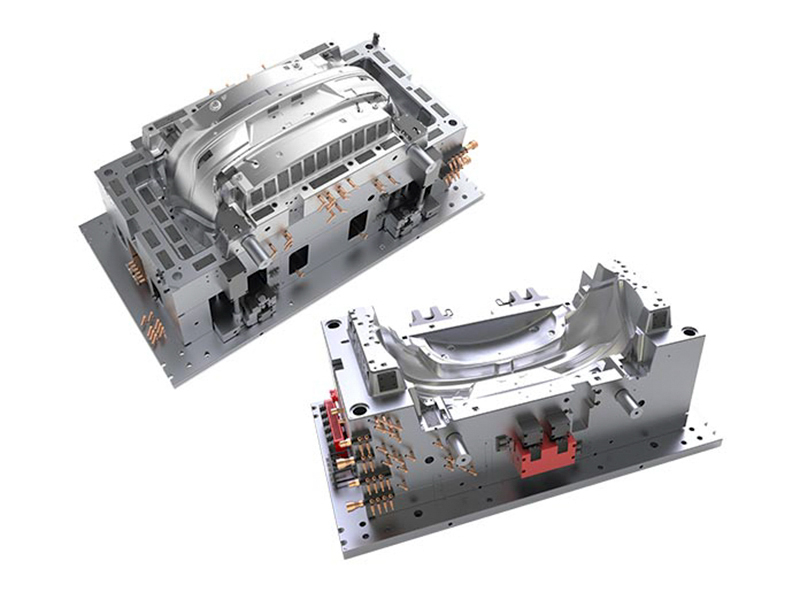
In modern vehicle manufacturing, engineers face increasing pressure to reduce overall vehicle weight while maintaining structural integrity and safety performance. This challenge directly influences Automotive mould design, where every structural decision affects the final component’s stiffness, durability, and mass. Lightweight structures improve fuel efficiency and extend electric vehicle range, but insufficient rigidity can cause vibration, deformation, and reduced performance. Achieving the suitable balance requires a strategic integration of material science, geometry optimization, and advanced simulation technologies.
Understanding the Relationship Between Stiffness and Weight
Definition of stiffness
- Stiffness is a component’s resistance to deformation under applied load.
- It depends on material modulus, moment of inertia, and structural geometry rather than thickness alone.
Impact of mass reduction
- Reducing material thickness lowers overall weight.
- However, excessive thinning may decrease bending resistance and structural stability.
Engineering balance
- The goal is to improve the stiffness-to-weight ratio rather than focusing on either factor independently.
- Intelligent geometry often delivers better performance than simply adding material.
Material Selection Strategies
High-modulus engineering plastics
- Materials such as glass-fiber-reinforced PP or PA significantly enhance stiffness without substantial weight increase.
- Reinforcement fibers improve tensile and flexural strength.
Fiber orientation control
- During injection molding, fiber alignment follows the melt flow direction.
- Controlled flow paths optimize mechanical strength in load-bearing directions.
Hybrid material approaches
- Combining plastic components with metal inserts enhances rigidity where necessary.
- Overmolding techniques allow localized reinforcement without increasing overall mass.
Structural Geometry Optimization
- Rib design instead of thick walls
Adding ribs increases bending stiffness efficiently.
Rib thickness is typically 40–60% of the nominal wall thickness to prevent sink marks.
- Curvature and contour utilization
Curved surfaces and boxed sections naturally resist bending.
Three-dimensional geometries distribute stress more effectively than flat panels.
- Topology optimization techniques
Digital tools generate material-efficient shapes based on load conditions.
Organic structural patterns reduce unnecessary mass while preserving strength.
Wall Thickness Management
Uniform thickness principle
- Even wall thickness prevents uneven shrinkage and internal stress.
- Balanced sections reduce warpage after cooling.
Localized reinforcement
- Critical load zones may require slight thickness increases.
- Targeted strengthening maintains global lightweight performance.
Avoiding overdesign
- Excess thickness increases weight without proportionate stiffness gain.
- Simulation ensures material is placed only where structurally necessary.
Simulation and Digital Validation
Finite Element Analysis (FEA)
- Simulates real-world loads and vibration conditions.
- Identifies weak points and areas of excessive deformation.
Mold flow analysis
- Predicts fiber orientation, filling behavior, and cooling patterns.
- Optimizes gate placement to improve mechanical consistency.
Iterative virtual testing
- Engineers refine geometry digitally before physical production.
- This accelerates design validation and ensures stiffness targets are met.
Cooling System Design Influence
Uniform cooling channels
- Even cooling prevents differential shrinkage.
- Stable dimensional accuracy preserves structural alignment.
Stress reduction through thermal balance
- Controlled cooling reduces residual stresses that may compromise rigidity.
- Balanced thermal management supports predictable mechanical performance.
Vibration and NVH Considerations
Noise, vibration, and harshness (NVH)
- Lightweight parts must still dampen vibrations effectively.
- Rib placement and material selection affect vibration absorption.
Modal analysis integration
- Simulation predicts natural frequencies of components.
- Design adjustments prevent resonance issues.
Balancing stiffness and lightweight performance in Automotive mould design requires a multidimensional engineering approach. Through optimized geometry, advanced material selection, fiber orientation control, and digital simulation tools, engineers can achieve good structural integrity without unnecessary mass.
Rather than relying on thicker walls, effective designs utilize ribs, curvature, and topology optimization to distribute loads efficiently. Uniform wall thickness, balanced cooling, and precise processing parameters further ensure dimensional stability and mechanical reliability.