



 Search...
 English
Injection Molding Structure and Principles of Drawer Mould
Introduction to Drawer Mould in Injection Molding
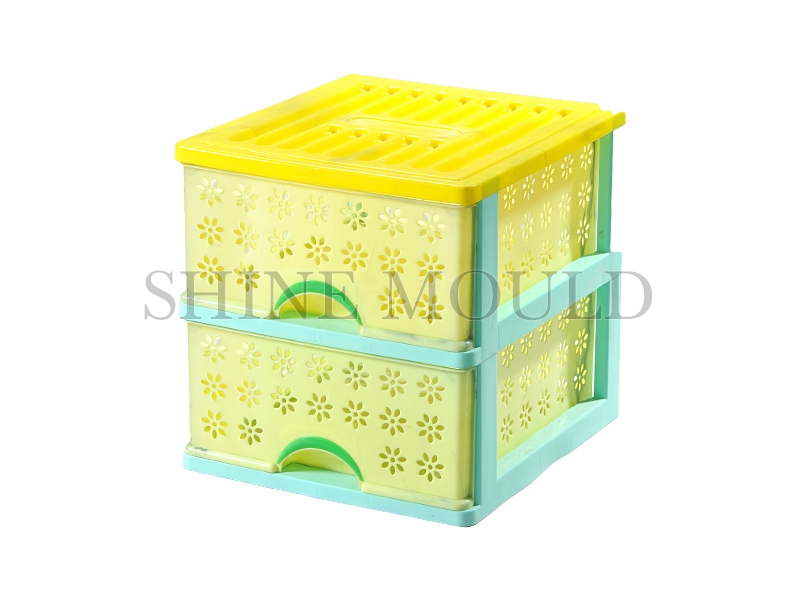
A Drawer Mould is a specialized injection mould used to manufacture plastic drawers commonly found in household storage units, cabinets, office furniture, and industrial organizers. These products often require precise dimensions, smooth sliding surfaces, and sufficient mechanical strength to support repeated use. As a result, the mould used to produce them must be carefully engineered to ensure accuracy, durability, and high production efficiency.
Overall Structural Composition
The basic construction of a drawer mould consists of multiple integrated systems that work together during each molding cycle. These systems typically include the mould base, cavity and core, runner and gate system, cooling channels, ejection mechanism, and ventilation elements. The mould base provides overall support and alignment, ensuring that all internal components remain stable under high clamping force. Each structural element is precisely machined to withstand repeated thermal and mechanical stress, allowing the mould to operate reliably over long production runs.
Cavity and Core Design Characteristics
The cavity and core are the critical components because they directly determine the external and internal shape of the plastic drawer. The cavity forms the outer surfaces, including visible faces and decorative details, while the core shapes the interior volume and functional features such as reinforcement ribs or sliding grooves. Drawer products often have relatively large flat surfaces, which makes dimensional accuracy and surface flatness especially important. Proper draft angles and surface polishing are applied to ensure smooth demolding and consistent appearance, while maintaining sufficient strength in load-bearing areas.
Runner and Gate System Function
The runner and gate system controls the flow of molten plastic from the injection machine into the mould cavity. During the injection stage, the melted polymer travels through the runner channels and enters the cavity through one or more gates. For drawer moulds, gate placement must be carefully considered to achieve uniform filling across wide surfaces and corners. Balanced flow helps prevent defects such as warping, sink marks, or weld lines, which can affect both appearance and functionality. A well-designed runner system also improves material utilization and reduces cycle time.
Cooling System and Temperature Control
The cooling system plays a decisive role in the working principle of injection molding. Cooling channels embedded within the mould circulate coolant to extract heat from the molten plastic after injection. Since drawers often have varying wall thicknesses and large flat areas, uniform cooling is essential to prevent deformation and internal stress. Effective thermal control shortens the molding cycle while maintaining dimensional stability. Inadequate cooling can result in uneven shrinkage, reduced strength, and poor surface quality.
Ejection System Operation
Once the plastic drawer has cooled and solidified, the ejection system is activated to remove the product from the mould. This system typically includes ejector pins, ejector plates, and guiding components. Because drawers are relatively large and thin-walled, the ejection force must be evenly distributed to avoid bending or surface damage. A properly designed ejection system ensures smooth release of the product while preserving its shape, edges, and functional features.
The basic construction and working principle of a drawer mould reflect the precision and coordination required in modern injection molding. Each component, from the cavity and core to the cooling and ejection systems, plays a vital role in shaping functional and durable plastic drawers. By understanding how these structural elements work together during the molding cycle, manufacturers can optimize mold design, reduce defects, and improve production efficiency. A well-engineered drawer mould ensures reliable performance, long service life, and consistent product quality across a wide range of applications.
-1.jpg)
.jpg)
